
Many local business owners believe digital integration means setting up a website, posting on social media, or downloading an app. That thinking leaves enormous value on the table. Real digital integration reshapes how your business processes operate, how your team communicates, and how your customers experience every interaction with you. Customer engagement improves measurably when businesses go beyond surface-level tech and connect their tools, data, and people into a coherent system. This guide explains what that actually looks like and why it matters for local businesses competing in an increasingly digital market.
Table of Contents
- What does digital integration really mean?
- Key benefits of integrating digital solutions
- Beyond the tech: Process, people, and pitfalls
- Steps to integrate digital solutions successfully
- Why most local digital efforts stall: Lessons from the field
- Take your business further with digital integration support
- Frequently asked questions
Key Takeaways
| Point | Details |
|---|---|
| Go beyond apps | Real digital integration means redesigning how your business works and interacts with customers, not just adding technology. |
| Drive loyalty and visibility | Digital solutions improve communication, trust, and competitive edge for local businesses. |
| Performance matters | Strategic integration leads to measurable operational improvements and stronger outcomes. |
| Plan before you build | Prepare your processes and data before adopting new digital tools for lasting results. |
What does digital integration really mean?
Now that we’ve outlined why digital integration is often misunderstood, let’s define exactly what it means for local businesses.
At its core, digital integration is the process of connecting your technology, workflows, customer touchpoints, and data so they function together rather than in isolation. It is not simply about purchasing software or building a website. It is about transforming how your business actually operates, so that digital tools drive consistent, measurable improvements across every part of the customer journey.
Consider a local plumbing company. Digitizing might mean putting a contact form on a website. Integration means connecting that form to a scheduling platform, automatically sending a confirmation to the customer, updating the technician’s calendar, triggering an invoice after the job, and logging customer data for future follow-up. Every step talks to the next. That is the difference.
Here is what genuine digital integration covers for a local business:
- Connected systems: Your booking, payment, communication, and data tools share information automatically
- Consistent customer profiles: Every staff member sees the same customer history, preferences, and past interactions
- Streamlined processes: Redundant manual steps are eliminated through automation and linked platforms
- Reliable data: Decisions are made based on real-time information rather than guesswork
- Trust signals: A consistent online presence, from Google Business to review platforms to your website, builds credibility
“Digital integration improves customer engagement and loyalty by enabling direct communication, better experiences, and trust signals such as consistent brand presence and unified profiles.”
A common myth is that only large corporations need this level of integration. That is simply not true. Small and mid-sized businesses that pursue scalable digital transformation often outperform larger competitors precisely because they can move faster and adapt their processes without layers of bureaucracy slowing them down.
Key benefits of integrating digital solutions
With a clear understanding of digital integration, let’s examine why these strategies are vital for achieving real business results.
The benefits are not theoretical. When local businesses integrate their digital tools and processes strategically, the outcomes show up in measurable ways: more bookings, stronger customer retention, improved staff productivity, and better insight into what is working.

Improved customer engagement and loyalty
When your systems are connected, every interaction with a customer feels smoother. They receive timely responses, personalised communication, and consistent service regardless of which staff member they deal with. Direct communication and trust signals created through consistent digital profiles and streamlined interactions translate directly into loyalty and repeat business.
Enhanced visibility and reach
A properly integrated digital presence means your business information is accurate and consistent across every platform where customers search for you. This consistency is one of the most overlooked ranking factors in local search, and it has a direct impact on whether potential customers find you or a competitor.
Operational efficiency and data-driven decisions
| Area | Before integration | After integration |
|---|---|---|
| Booking management | Manual calls and paper records | Automated scheduling with confirmations |
| Customer communication | Ad hoc emails and phone calls | Centralised messaging with history |
| Performance tracking | Monthly manual reporting | Real-time dashboards |
| Staff coordination | Phone-based updates | Integrated calendars and task tools |
| Invoice and payments | Separate manual processes | Automated billing linked to job completion |
The efficiency gains alone can free up significant staff time each week. That time can go back into serving customers better or growing the business.
Key benefits at a glance:
- Reduced administrative workload through automation
- Faster response times to customer enquiries
- Better staff coordination and fewer errors
- Personalised customer experiences at scale
- Real-time performance data for smarter decisions
The evidence backing these outcomes is growing. Research on 61,054 U.S. SMEs published in Information Technology for Development in 2025 found that technologies supporting dynamic capabilities, including analytics, mobile platforms, IoT, and cloud tools, consistently improved business performance across the board. That is not a small sample. That is compelling evidence that digital integration genuinely moves the needle for smaller businesses.
Supporting this with the right infrastructure matters too. Exploring business cloud strategies that match your current scale and growth trajectory can make the difference between a system that supports growth and one that creates new bottlenecks.
Beyond the tech: Process, people, and pitfalls
Understanding benefits is not enough. Let’s pinpoint the underlying shifts in process and thinking that make digital integration effective.
Here is where most local businesses stumble. They invest in tools and then wonder why nothing has improved. The problem is almost never the software. It is the approach. Technology does not fix broken processes. It accelerates them, for better or worse.
“Transformation requires redesigning processes and ensuring data readiness before building or integrating systems. Simply adding an app or moving forms online is not digital transformation.”
The most common pitfalls local businesses encounter:
- Jumping to tools without mapping current processes: If your existing booking process is confusing, automating it just creates faster confusion. Start with process clarity.
- Poor data quality going in: Integrating systems that contain inconsistent, duplicate, or outdated customer data produces unreliable outputs. Clean data before you connect systems.
- Skipping staff training: Even the best platform fails if your team does not understand it or resists using it. Training is not optional.
- Underestimating culture change: Digital integration often shifts how decisions are made and who has access to information. Leadership needs to model the new behaviours.
- Trying to do everything at once: Implementing five new tools simultaneously overwhelms staff and makes it nearly impossible to identify what is working.
Reviewing cloud migration best practices before selecting or moving any systems is a practical step that can prevent costly mistakes later.
Pro Tip: Before choosing any new digital tool, map the process it is meant to support on paper first. Identify every handoff, decision point, and data input. This map becomes your guide for evaluating whether a tool actually fits your needs, rather than whether it has impressive features.
Steps to integrate digital solutions successfully
To put this into practice, here’s a step-by-step path to impactful digital integration tailored for local businesses.
A structured approach removes the guesswork and dramatically increases your chances of seeing real results. Measurable performance gains from digital adoption consistently appear when transformation translates into capabilities and strategy, not just technology adoption for its own sake.
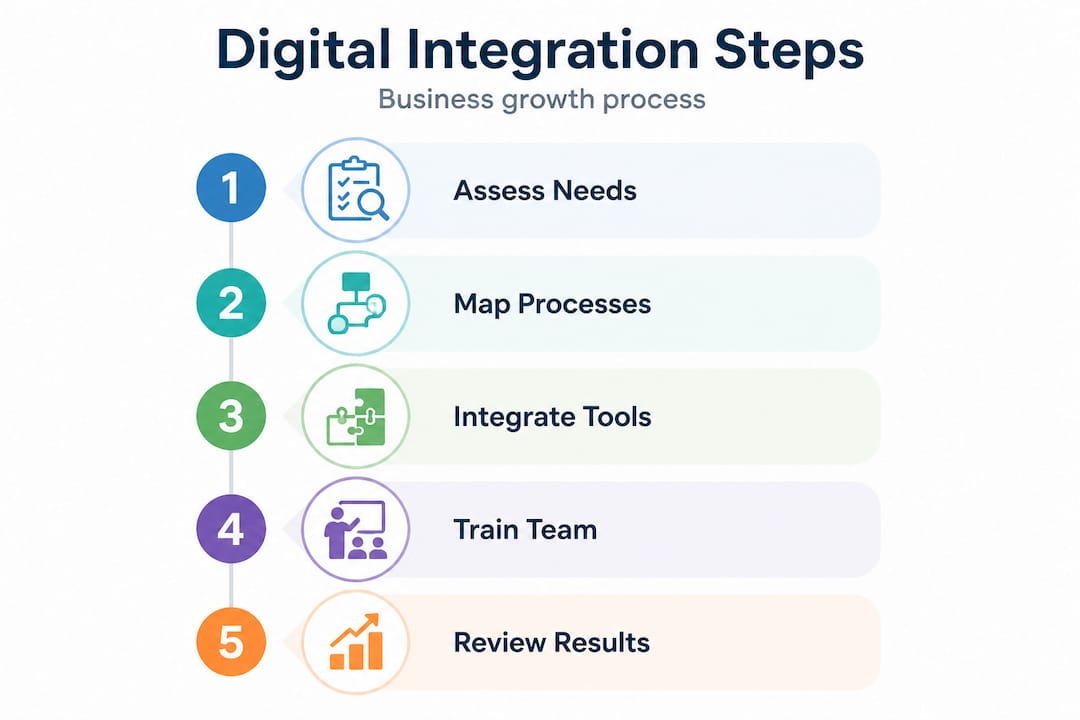
Follow these steps to build a solid foundation:
- Assess your digital readiness: Review your current tools, data quality, and staff comfort with technology. Identify the gaps and the strengths you already have.
- Map your core customer journey: Trace every step a customer takes from discovery to purchase to follow-up. Note where friction, delays, or inconsistencies exist today.
- Redesign key processes before selecting tools: Resolve the process issues first. Define the ideal flow, then identify which technology supports it.
- Choose systems based on integration capability: Prioritise platforms that connect with your existing tools via APIs or built-in integrations. Avoid siloed software that cannot share data.
- Plan a phased rollout: Introduce one or two connected tools at a time. Build confidence and competence before expanding.
- Train your team with purpose: Go beyond button-clicking tutorials. Help staff understand why the new process works the way it does and how it benefits customers.
- Measure outcomes against clear goals: Define what success looks like before you start. Track booking rates, response times, customer satisfaction scores, and staff hours saved.
| Integration phase | Focus area | Key action |
|---|---|---|
| Phase 1: Assess | Current state review | Audit tools, data, and processes |
| Phase 2: Design | Process improvement | Map ideal flows and identify gaps |
| Phase 3: Select | Technology choice | Choose connected, scalable platforms |
| Phase 4: Launch | Phased rollout | Pilot with one team or one process |
| Phase 5: Measure | Performance tracking | Review metrics and adjust as needed |
Understanding cloud scalability benefits at the selection stage can help you choose platforms that grow with your business rather than creating expensive replacement cycles down the road.
Pro Tip: Set a 90-day checkpoint after each integration phase. Review what the data tells you, gather honest feedback from staff and customers, and make adjustments before moving to the next phase. Small corrections early prevent large problems later.
Why most local digital efforts stall: Lessons from the field
With practical steps in hand, here is a candid look at what makes digital transformation succeed or fail.
We have seen a consistent pattern in how local businesses approach digital integration. The ones that struggle share a specific mindset: they treat technology as a shortcut. They believe the right app will save the business, that moving their forms online will transform their customer experience, or that a new booking system will solve their retention problem. It rarely works that way.
The businesses that genuinely succeed share something different. They start by asking what their customers actually need, not what technology can do. They spend more time understanding their own processes than evaluating software features. And they move slowly on purpose.
Here is the contrarian wisdom that most digital consultants do not say out loud: the businesses that integrate the fewest tools most effectively almost always outperform those that adopt the most tools poorly. Complexity is not a sign of digital maturity. Coherence is.
Data quality is the most overlooked factor in all of this. Businesses often have years of customer records scattered across spreadsheets, email threads, and outdated CRM systems. Connecting those systems without first cleaning and organising the data amplifies every inconsistency. You end up with automation that sends the wrong message to the wrong person, or analytics dashboards that show misleading numbers because the underlying data was never reliable to begin with.
Culture and leadership matter more than any specific tool. When a business owner genuinely models the new behaviours, asks for the data before making decisions, and publicly acknowledges when the process improvements made a difference, staff follow. When leadership treats the digital initiative as an IT project and steps back from it, adoption stalls within months regardless of how good the platform is.
Start small. Pick one customer interaction that is currently frustrating, map it properly, fix the process, and then connect the right technology to it. Do that well. Then repeat. That compounding approach builds confidence, delivers visible wins, and creates a team that is genuinely enthusiastic about the next phase rather than dreading it.
Take your business further with digital integration support
Ready to make digital integration work for your business? Here is where to get reliable support.
Knowing the steps is valuable. Having the right support in place as you take them makes all the difference. Local businesses that partner with dedicated digital growth services move faster, avoid the most common pitfalls, and see results that justify the investment.
Whether you are at the assessment stage or already partway through your integration journey, connecting with a platform built specifically for local service providers gives you tailored guidance rather than generic advice. The local business growth platform at Local Service Growth is designed to help business owners like you identify the right next steps, connect the right tools, and build the visibility and efficiency your business deserves. For deeper digital capability building, Stellor digital solutions offers specialised expertise in technology integration and strategy for growth-focused businesses. Your next step does not have to be complicated. It just has to be the right one.
Frequently asked questions
What is the difference between digital integration and simple digitization?
Digital integration transforms processes and strategy rather than simply moving tasks online or adding a new app. It requires redesigning how your business operates and ensuring data readiness before connecting systems.
How does digital integration improve customer loyalty for local businesses?
Integration boosts loyalty by creating consistent and direct communication across every customer touchpoint. When customers experience reliable, personalised service every time, trust builds and they return.
Are there risks to integrating digital solutions too quickly?
Yes. Rushing integration without addressing process design and data readiness leads to compounded confusion, poor adoption, and missed results. A phased, process-first approach significantly reduces these risks.
What measurable results can local businesses expect from successful digital integration?
Businesses that integrate strategically see improved efficiency, stronger customer engagement, and a clearer competitive advantage. Research on 61,054 SMEs confirms that technologies aligned with business capabilities consistently improve measurable performance outcomes.